Showing posts with label Funny stuff. Show all posts

Tuesday, August 2, 2011

Ronaldo and Footballers as European Central Bank Collateral

Financial News reports that Bankia, the Spanish Bank, is offering Ronaldo and Kaka as collateral to the ECB for some financing. Ronaldo was supposedly acquired from Manchester United for GBP 80 million whereas Kaka was purchased for eur. 65 million.

The ECB has been accepting all sorts of junk as collateral lately but they might draw the line at Sepp Blatter and Irish footballers. Perhaps rugby players? Although seizing those muscular rugby chaps and taking physical custody in the event of default might be beyond the abilities of ECB personnel!

Wednesday, July 27, 2011

New Ban: Airbrushed Models in L'Oreal Ads

The nanny state strikes again in the UK. The latest menace? Aibrushed models. In order to protect the poor hapless consumer from "misleading advertising" (which, by the way, is an oxymoron), the UK Advertising Standards Agency has banned advertisements issued by L'Oreal ("because you're worth it") featuring Julia Roberts and Christy Turlington. The complainant, Liberal Democrat MP Jo Swinson, claimed that "There's a problem out there with body image and confidence. The way excessive retouching has become pervasive in our society is contributing to that problem." What a load of absolute tosh. One would have expected the watchdog to require some evidence of consumers being misled by these images of Julia Roberts and Christy Turlington. They were not deterred by the lack of evidence and get it completely wrong: "If advertisers go too far in using airbrushing and other post-production techniques to alter the appearance of models and it's likely to mislead people, then that's wrong and we'll stop the ads."

What about the free speech rights of the advertisers? By definition, advertisements entail a degree of puffery. Consumers with any degree of common sense would have taken such advertisements with a pinch of salt. Those lacking in that department deserve to be fooled. A ban is unnecessary. Disclosure on the part of L'Oreal about the retouching would have been sufficient to protect whatever consumer interest the advertising standards agency's mandate requires it to safeguard.

More at the BBC.

Tuesday, July 26, 2011

Lord Justice Sullivan on Wayne Rooney and Football

"It's a wonder he's got time to play football, he's making so many personal appearances," said Lord Justice Sullivan. "For Nike, for Coca-Cola. It's a wonder he's got time to practice."

Christopher Jeans QC, for sports management firm Proactive, replied: "Bearing in mind footballers train in the morning only, it's not what the man in the street would consider an onerous obligation."


The QC should try his hand at professional football since it is not very onerous! More at the Independent here.


Friday, July 15, 2011

In the Courtroom: Expert Witnesses on Feces + Dictionary on "Shit"

I've blogged previously about expert witnesses testimony - especially the views of some Irish judges about economists as experts - and came across this really funny post about a recent Iowa Court of Appeals decision about the need for expert testimony to establish whether something is feces. The case concerned an attack on a correctional officer by a prison inmate with a brown substance followed by him yelling, "I got you with shit." The inmate challenged his conviction claiming that the state had not adduced expert evidence to substantiate the charge of assault with feces.

The court did "not believe the identification of feces falls solely within the domain of expert testimony." According to the judge, "[i]f it looks like feces, if it smells like feces, if it has the color and texture of feces, then it must be feces. No witness with a degree in scatology was required, nor was scientific testing required to establish the fact the substance was feces."
The judgment is also noteworthy for its use of the dictionary for a definition of the word "shit." The judge elucidates on the "versaitility of the word 'shit'" with some humour (see footnote on page 7, internal citations omitted):
"Shit" is defined as excrement. Webster‟s Third New Int‟l Dictionary 2098 (1993). But, the word has also been defined as nonsense, foolishness, something of little value, trivial and usually boastful or inaccurate talk, and a contemptible person. Id. This now ubiquitous word has acquired numerous popular usages apart from its literal meaning. It has been used to describe people, places, and things and to express a wide variety of emotions such as disappointment, disgust, despair, resignation, amazement, awe, shock, anger, and surprise. For examples, see State v. Vance,  ("He is going to find the shit . . . ."); Estate of Harris v. Papa John’s Pizza,  ("[S]hould be on his „shit list‟ . . . ."); Civil Service Commission of Coralville v. Johnson,   ("You ain‟t going to be shit."); Wilson v. IBP, Inc.,  ("[T]his guy‟s full of shit."); Marks v. Estate of Hartgerink,  ("It takes a lot of guts and shit . . . ."); State v. Anderson,  ("[W]hat‟s this not guilty shit."); Knox v. Municipal Court of City of Des Moines,  ("You are still a Fascist and your swastika (indicating) Heil Harrison, Heil Harrison and all that shit."); Graves v. O’Hara,  ("We have f**king shit to haul . . . ."); State v. Shortridge, ("Holy shit, let‟s get out of here . . . ."); Peck v. Employment Appeal Board,  ("[A]sking what „shit jobs‟ were available."); State v. Findling,  ("I mean this is really big shit here."); Wiysel v. William Penn College, ("[H]is words were so much „sanctimonious shit.‟"); and Blong v. Snyder,  ("[They] told him the pieces he had run were all „shit.‟"). The remarkable versatility of the word "shit" is also demonstrated in George Carlin‟s "Filthy Words," a verbatim transcript of which is set forth in full in the appendix to the United States Supreme Court‟s opinion F.C.C. v. Pacifica Foundation.

My previous posts on dictionaries in the court are here and here. Paul MacMahon's views on dictionaries here.

Wednesday, July 13, 2011

Saggy Pants Banned: Overreaching Law?

The fashion police strikes in southerwestern Illinois. Collinsville's city council voted to ban saggy pants and impose criminal penalties for breach. Via the Chicago Tribune:
"The Belleville News-Democrat reports the ordinance forbids pants that ride lower than 3 to 4 inches below the waistline of the underwear. A first offense is punishable with a $100 fine, while a second offense would carry a $300 fine plus 40 hours of community service."

In another example of regulatory overreach at the national level, Congress failed to repeal a new lightbulb law; its first phase comes into effect from "Jan. 1 through 2014, [and] requires bulbs to be 25 to 30 percent more efficient. The second stage could require bulbs to be 60 percent more efficient by 2020. ... The restrictions could eliminate the familiar incandescent bulbs, which have used essentially the same technology since Thomas Alva Edison invented them.
Republicans ... said the new types of bulbs are too expensive. Prices range from about $1.50 for a halogen incandescent to $20 for light-emitting diode, or LED, bulbs, which are supposed to last 10 years. Regular bulbs today cost about 35 cents."
More at the NYT's website here.

Tuesday, July 5, 2011

Loopy Lawyers on TV

Prof. Thane Rosenbaum has an interesting piece in the WSJ on the changed depiction of lawyers on TV:
In these new shows [Harry's Law, Franklin &Bash, and Suits], ambulance chasers mainly chase skirts, and the street-smart lawyer is more like a street performer. Even the book-lined law office has become optional. The firm in "Harry's Law" also sells fine shoes. And the titular lawyers in "Franklin & Bash" initially practice out of a home office that is more "Animal House" than "The Paper Chase." In the recent film "The Lincoln Lawyer," the character played by Matthew McConaughey conducts business from the backseat of a Lincoln Town Car.

It wasn't always this way. In the 1960s, attorneys were portrayed in movies and on TV as austere and serious men who practiced law with great moral conviction. Atticus Finch, played by Gregory Peck in the film version of "To Kill a Mockingbird," remains the paradigm of that lawyerly vision, taking on an unwinnable case in a courtroom contaminated by prejudice.

He makes several good points so read the piece in full. Two omissions in the article:
1. The growth in the number of TV shows devoted to legal "analysis" - like the unbearable Nancy Grace - featuring a bevy of lawyers, former judges, jurors etc., dishing out sanctimonious opinions about the latest high profile case. It has been virtually impossible to find anything on the news channels in the US other than interminable analysis of the Casey Anthony trial for the last 10 days.
2. The rise of a special species of "celebrity" lawyers - think of the Anna Nicole Smith custody battle - who seem to be lifestyle coaches/personal managers/shrinks/pastors all rolled into one. They shed copious tears at the drop of a hat and behave more like reality TV actors than lawyers. They qualify as loopy lawyers?

Friday, June 24, 2011

Expert Witnesses in Irish Courts: "Incomprehensible" Economists!

The Independent quotes Supreme Court judge Fidelma Macken in an article about jurors watching too much TV: "The bane of most judges' lives is to see a group of economists coming into court speaking the most unbelievably incomprehensible language known to mankind and it couldn't be just that all the judges are dumb ...
There is this inescapable inability on the part of economists to explain what must be reasonably simple concepts in reasonably clear and simple terms."

Hilarious.

Wednesday, June 15, 2011

More on Dictionaries in the Supreme Court

Following on from Paul McMahon's post on the use of dictionaries, I thought I'd add a few more citations of interest. Paul observes that Irish judges are more "sensible" in their use of dictionaries than U.S. Supreme Court judges. While he may have a point, part of the explanation might be the difference in citation culture between the two systems. As a general matter, American lawyers/academics/judges tend to cite more thoroughly than others, and while other judges may be consulting dictionaries just as extensively as their American counterparts, perhaps they are not citing them as much? Perhaps Irish legislation is worded more clearly? It would be interesting to get an Irish judge's views on the issue.
Anyway, here are few more interesting references:
  •  ""Felon-setter"and "Helped jail republicans in England" were not words in respect of which one has to have recourse to a dictionary to know what they meant to an Irishman; they were equivalent to calling him a traitor."  (Berry v. Irish Times (S.C. 1973))
  • "To "download" a computer meant to "transfer (data) from one storage device or system to another" in accordance with the definition contained in The Concise Oxford Dictionary of Current English." (Regina v. City of London Magistrates' Court and Another, Ex parte Green (Q.B. 1997).
  • "I do not think that any useful guidance can be derived from dictionary definitions as to what is meant by the expression "primary education". Its meaning, in the vast majority of cases, is clear. It denotes the stage of a child's education lasting from ages six to twelve and does not extend to the kind of training and human development that takes place from birth to age four. (Sinnott v. Minister for Education (S.C. 2001).

Tuesday, June 14, 2011

Dictionaries in the Irish Supreme Court

Apropos a recent article in the New York Times about the increasing citation to dictionaries by the U.S. Supreme Court, I did a quick search on Justis for the use of dictionaries in judgments issued by the Supreme Court of Ireland. There were 200 results (by way of comparison, the US Supreme Court "used dictionaries to define 295 words or phrases in 225 opinions in the 10 years starting in October 2000") and the court used the dictionary to interpret the meaning of words ranging from "amicus curiae" to "cattle" to "advance" to "instalment" to "sum" to "produce." In addition to frequent citation to the Oxford English Dictionary, the Irish Supreme Court also referred to Murray's New English Dictionary, Stroud's Judicial Dictionary, and Tomlins-Jacobs Law Dictionary. I also observed that Justice Fennelly - who is one of the more frequent users of the dictionary - shows fine taste in favouring the OED!

Among the gems:
  • "The word, “ouncil” or “ouncel” is obscure. It does not appear in any dictionary even in the longest version of the Oxford Dictionary. Perhaps it is unique to Kilkenny. From context, it clearly means a weighing machine." (Justice Fennelly in Simmonds v Kilkenny County Borough & ors (2011)
  • "a slot machine is defined in the Oxford dictionary as a machine which is operated by the insertion of a coin in a slot" (Director of Public Prosecutions v. Cafolla (1994))
  • ...[crunch] has a very clear and specific meaning, whether we take it in its modern spelling of"crunch," a spelling which has been known for over a hundred years, or its older spelling, "craunch" which has a history of some 250 years. Whatever be the origin of the word, whether it be as suggested by some persons an onomatopoeic amalgamation of the words "crush" and"munch," or whether, as suggested by one learned lexicographer, it is an echoistic modification of the word "crush,"nevertheless, as the word "crunch," it is established in modern English usage with a clear, specific meaning, and the strongest evidence of that fact is the spontaneous exclamation of the workman on testing the result of the boiling, which he described as a "great crunch." (Fry-Cadbury (Ir.) Ltd. v. Synnott (1935)).

Monday, May 30, 2011

Iran Setting Up "National Internet"

No, I did not make this up.

The WSJ reports that Iran is taking steps toward an aggressive new form of censorship: a so-called national Internet that could, in effect, disconnect Iranian cyberspace from the rest of the world.
The leadership in Iran sees the project as a way to end the fight for control of the Internet, according to observers of Iranian policy inside and outside the country. Iran, already among the most sophisticated nations in online censoring, also promotes its national Internet as a cost-saving measure for consumers and as a way to uphold Islamic moral codes.

Anyone believing recent proposals for benign Internet regulation at the G8 level might want to read the full article.

Sunday, September 26, 2010

Funny EU Maps

The talented graphic designer Yanko Tsvetkov has some very funny maps of the EU. Here's a taste:


The EU according to the US:


Monday, April 19, 2010

Ash Crisis? Iceland"s revenge?

If there is a God above, s/he must be an Icelander! After receiving plenty of abuse from the Brits about refusals to repay their debts, Icelanders must be chuckling quietly now that the British economy has been hammered by the so called "ash crisis." And they can use language very familiar to British creditors - "act of God" - to escape all blame!

I am stranded in Rome - just another victim of the mess. If EU transport authorities get their act together I might return home at some point. I am not counting on the Irish authorities to do anything useful. At least there is plenty of gelato to ease the pain.

Wednesday, December 30, 2009

Diplomatic Immunity: Saudi law can't keep an Irish Ambassador from his drink!

Via the Independent:
Department of Foreign Affairs papers from 1977-78 show the embassy in Jeddah used an Italian company to secretly ship in cases of wine and whiskey. The then ambassador Eamon O'Tuathail insisted cargo documents be marked "preserves or furniture" to throw police off the scent, as Saudi officers were posted on security outside his home and office. Mr O'Tuathail wrote several letters to the Irish embassy in Rome to help arrange the shipments, claiming Trieste-based firm Alberti was the only one willing to falsify documents.
"As usual, Alberti should arrange that the boxes inside the containers should be sealed and have no indication on the outside as to contents," the ambassador wrote to official Billy Hawkes in Rome in February 1978.
"The shipping documents should show 'furniture'. We now have the police sitting outside both the office and residence!"

Tuesday, December 29, 2009

Where Your Taxes Go: Eur.150 million for "Halting Bays"

I'm not averse to Travellers having some place to park their caravans, but cannot imagine why my tax money should be spent on building monuments to folly costing millions all over the country. After all, you and I pay an arm and a leg to park our cars in the few spaces available to us. Clearly, we live in a nanny state gone mad. Here's proof via the Independent:
...figures reveal that 25 of the county and city councils spent €121m accommodating Travellers in halting sites and in houses over the past five years. Details were not available for the remaining nine primary local authorities, meaning that the total spend is likely to top €150m.
Town councils such as Tullamore, Mullingar and Letterkenny, manage their own budgets, which means that the total is likely to be higher again. Galway City Council emerged as one of the most generous of all local authorities, spending €10m over the past five years. The council also spent over €1.56m on five bays in a halting site in Doughiska, working out at around €300,000 each.
In South Dublin, the council went even further -- shelling out over €500,000 per bay in a 10-bay site in Rathfarnham. At current market prices, €500,000 would buy a comfortable four bed semi-detached house in the Rathfarnam area. South Dublin was by far the highest spending council, forking out €40.3m on Traveller accommodation since 2005. Occupiers of halting sites pay rent to the local council, but the amount is understood to vary according to circumstances.

Elsewhere, Cavan County Council spent a total of €886,965 over five years. Cavan's thrifty total worked out at an average of €80,663 per permanent house and €105,362 per halting bay.

Over 150 million Euro on halting bays? Seriously?!

Tuesday, December 22, 2009

Ireland Wins OECD Drinking Contest

Pardon the headline, but I could not resist it after noticing this nugget from the OECD Health Data 2009: Ireland consumes 13.4 litres of alcohol per capita beating all OECD countries for which data was available in 2007. The Irish had to fend off stiff competition from the Czechs and Danes (12.1 litres per capita). Surprisingly, the British (11.2 litres per capita) did not even finish in the top three! The Finns finished fourth with 10.5 litres per capita. There was no data for the US in 2007, but in 2006 they consumed a mere 8.6 litres per capita.

The Irish might need to work harder to maintain top place as recent years show declining consumption: from a peak of 14.5 litres in 2001, consumption has declined steadily to stabilise at 13.4 over the last couple of years.

Sunday, December 13, 2009

Bash a Banker

An enterprising "inventor" from Suffolk is laughing all the way to the bank after coming up with a way to make money at the expense of those unpopular bankers. Appropriately titled "Whack-a-Banker," it's a simple game as described by the BBC:
Players, who are promised a "truly rewarding banking experience", pay 40p to hit as many bankers as they can in 30 seconds.When a customer wins a voice says: "You win. We retire. Thank you very much to the taxpayer for paying our pensions."

I know that some of you cannot wait to have a go at it, so I've found an online version that you can try out by clicking on this link.

It's not the most challenging of games, but it could be a pleasant diversion while waiting interminably on the phone for your call to the bank to be connected.

Friday, December 4, 2009

IMF 'unlikely to take over Irish economy'

This is the mind-boggling title of a piece in the Irish Examiner today. According to the paper, "A top official at the International Monetary Fund (IMF) has said that the organisation is not likely to take over the running of Ireland's finances." Whew! We were all panicking! I had no idea that the IMF was in the business of taking over national economies.

The article also contains this gem: "Caroline Atkinson, director of external relations with the IMF, says the organisation views itself as a "doctor with a patient", rather than police "with a criminal"."

Given the state of its parlous finances, the IMF is more of a patient than Ireland.

Saturday, November 28, 2009

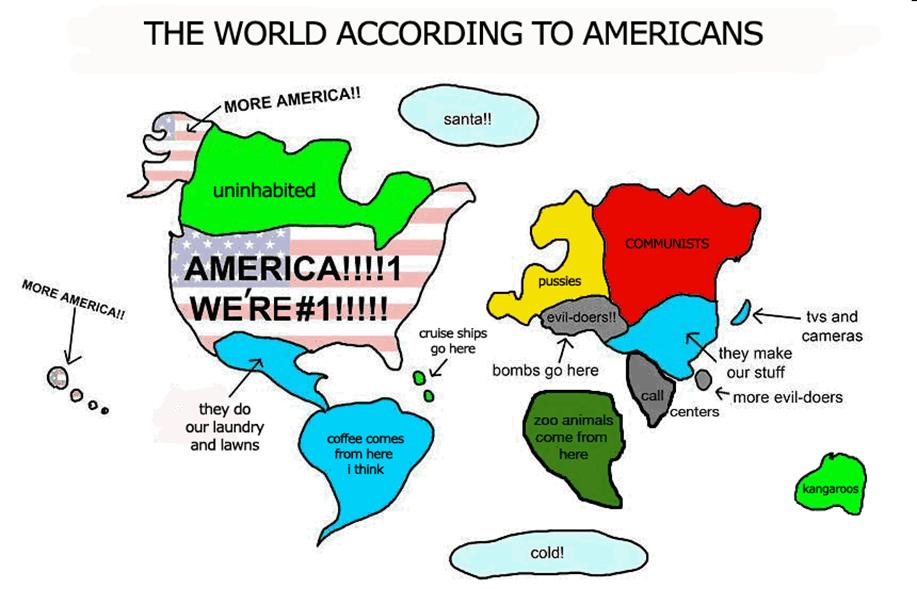
America and the world

Have a look at this hilarious map of the world (source: Ritholtz):